View Categories

Lens Types

A brief description of the differences between lenses and when to use them.

Lenses fall into three main groups:
Fixed focal length lenses (also known as ‘prime’ lenses)
Zoom lenses
Specialist lenses

Fixed focal length (or ‘prime’) lenses comprise:
Wide angle
Standard
Telephoto

Zoom lenses have variable focal lengths and cover various ranges from wide to telephoto

Specialist lenses – for example macro, fisheye, tele-convertors and tilt/shift lenses

Generally speaking, lenses at the wider end of the scale are best used for photographs where you wish to include a scene encompassing a wide view. It might be a landscape with a mountain vista, a seascape, a large group of people, a firework display or a night time view of the Milky Way.

All the following focal lengths are expressed in mm and relate to ‘full frame’ (aka: 35mm film sized camera sensors). The closer the focal length of a lens is to 50mm, the closer the effect the lens gives to the human eye. Please see the section on sensors for more information on camera sensor size and how it affects equivalent lens focal length.

Wide angle lenses range from an ultra wide 14mm to a moderately wide 35mm. The 20mm, 24mm and 28mm focal lengths are probably the most common wide angle lenses, and these are very popular for landscape photography.

Use a 20mm or wider lens to include dramatic foreground detail in a landscape. Longer focal lengths can show parts of a scene more selectively. The 35mm focal length is a good versatile focal length as it can be used for most subjects (including individual environmental portraits showing a subject in an appropriate environment – or portraits of couples). Lenses wider than about 28mm are not suitable for portraits as they distort facial features – it is far more flattering to use a medium telephoto in the range of 50–105mm for individual portraiture.

Standard focal length lenses are either 50 or 55mm. These are closest to what the human eye can see (all be it within a hard rectangular frame, whereas we see that angle of view with an awareness of the periphery of a scene).

Common telephoto focal lengths range from a moderate 85mm or 105mm up to 300mm. Even longer lengths are available – for example 500mm and upwards but these are very expensive. For example the Nikkor 800mm costs nearly £20,000. The most common lengths are 85mm, 105mm, 135mm, 200mm and 300mm. The higher the number the larger (closer) the subject will appear in the frame and the flatter the perspective will appear. Focal lengths around 85mm to 105mm are ideal for portraiture, while 200–300mmm are good for nature (or picking out details in a landscape) and 300mm–400mm is ideal for bird and aircraft photography.


[ more to follow ] 

Powered by BetterDocs

BPG Help

Look for the

I’m here to help! Let me be your guide to familiarise you with our site.

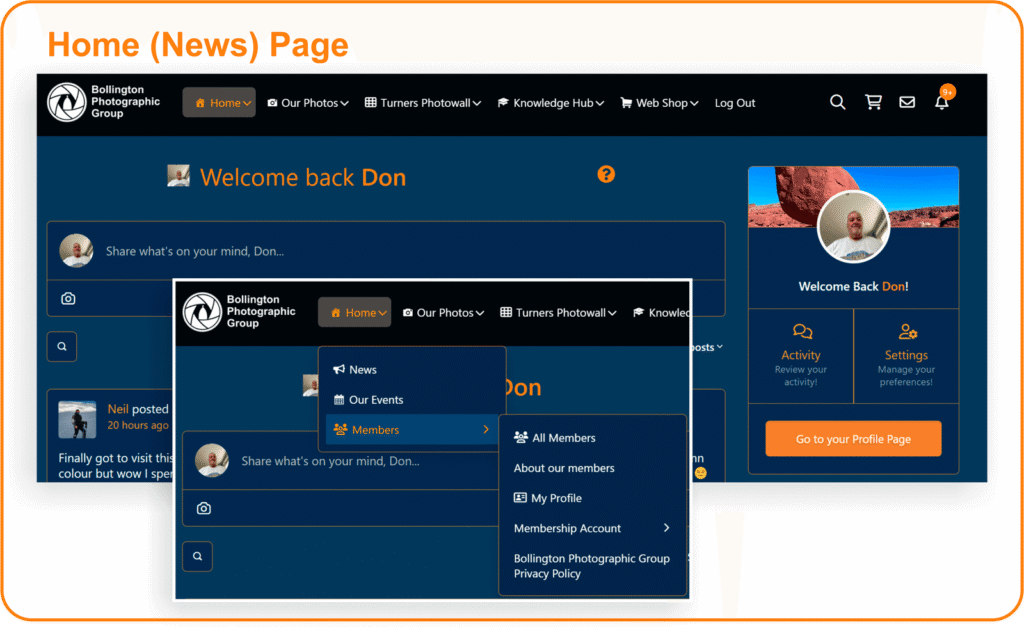
This is your starting page

To get started, use the left menu on your laptop to explore membership details, upcoming events, and ways to get involved in activities and discussions. We encourage you to post on this page and don’t forget to add your images to the members’ archival galleries for inspiration and ideas.  Our photographic pages are also grouped together in the main menu, making it even easier to find what you’re looking for.
For ease of use, popular pages are  accessible from each menu section. To make the most of your membership – please read the navigation hints underneath.

We encourage you to post on this page and don’t forget to add your images to the members’ archival galleries for inspiration and ideas. 

To get started, simply open the  hamburger menu to find galleries of photowalks, photo-wall entries, and member profiles. Use the ‘+’ to open the sub-menus.  You’ll  find information about upcoming events, including workshops, photography classes, and community gatherings.
Our photographic pages are all grouped together, making it even easier to find what you’re looking for.
For ease of use, popular pages are  accessible from each menu section. To make the most of your membership – please read the navigation hints underneath.

Welcome to your Member Profile Access Guide

The Profile Page is Your Personal Hub

  • Our website is built for members like you – to connect, share, and interact with others. To make this possible, we store some basic information about you, which helps personalize your experience.
  • Everyone uses the site differently, so some areas may be more relevant to you than others.  This quick guide will help you to get the most out of your membership.
Your Profile Page brings together everything about your activity… all in one place!

The Profile Page lists your Activity

  • Your Profile Page brings together everything about your activity on our site – posts, comments, messages, photos, subscriptions, and more – from your most recent entry to your first.

Your Profile Page lists all your activity… organised chronologically!

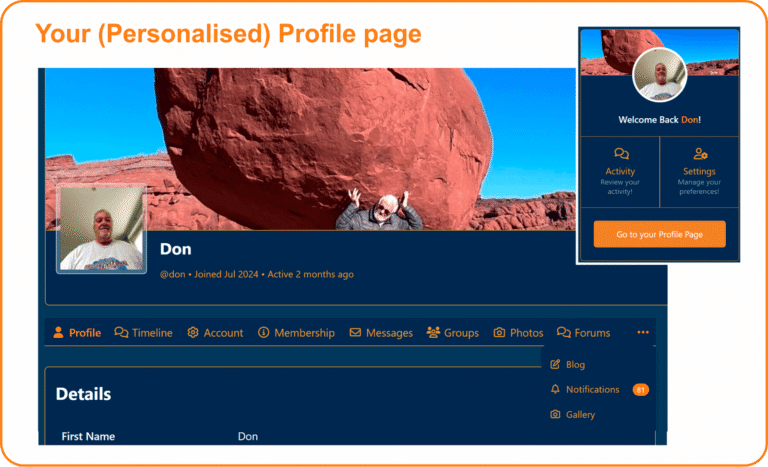
The Profile Page contains...

  • Your Profile Info
  • Timeline – a feed of all your activity
  • Account Settings – update login, notifications, privacy, data export, or delete your account
  • Membership – view or change your membership, see past transactions
  • Messages – conversations with other members
  • Groups – your subscribed groups
  • Photo Gallery – images you’ve posted
  • Forums & Blogs – your contributions
  • Notifications – alerts and updates
  • Personal Gallery – create your own photo collection

Navigate to your membership Profile

  • Easiest way: From the members’ news page, click the large orange button under your profile photo labeled “Go to your profile page”.
  • On desktop or mobile: Use the Home menu → Members dropdown → then select Profile Page or Membership Account.

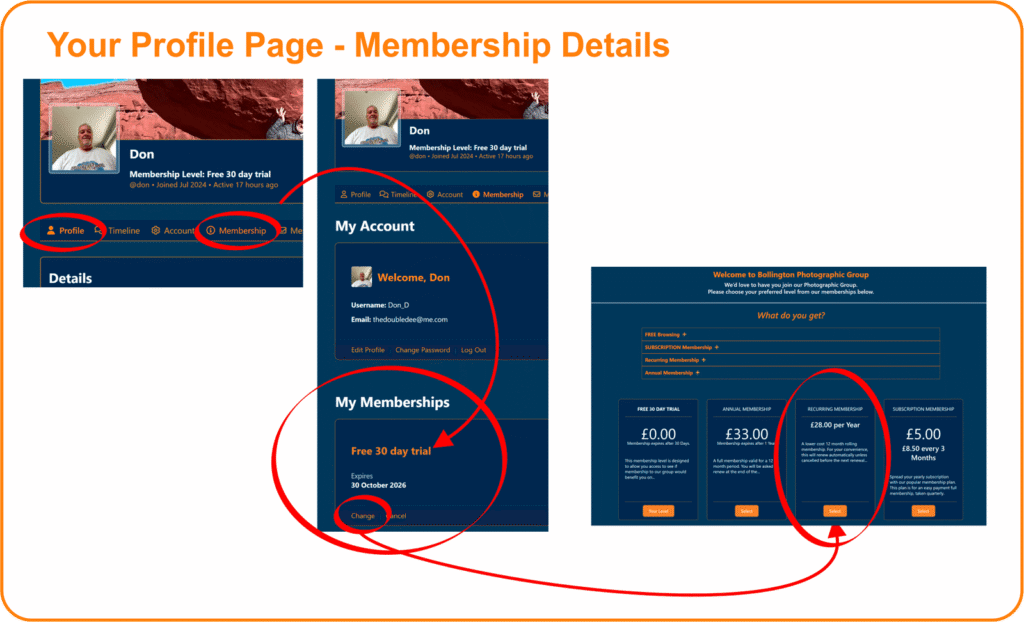
Your Membership

You can change or cancel your subscription anytime during your membership.
  • Follow: Home → Members →  Membership Account.
  • Or: Home →  Profile Page → Membership Account.
How to adjust your subscription:
  • At any stage during your membership period, you may alter (or cancel – shock horror!!) your subscription payments to the group. Please note this is only valid with a current membership.
  • Any new subscription selected will commence after the expiry of the previous subscription period.
💳 Note: Payments are securely handled by Stripe. We don’t store and cannot access your card details. If your subscription lapses, it will be cancelled for security reasons, and you’ll need to reapply for membership.
How can we help you?

Thank you for your interest in Bollington Photographic Group. 

Please fill in your details and we will get back to you as quickly as we can.